Chicago, IL 60601
FREE CONSULTATIONS 312-462-4200
TOLL FREE 833-462-4200

Are Nurses Ever Liable for Birth Injuries in Illinois?
 Mothers need around-the-clock attention during childbirth to avoid injury. Doctors and other medical personnel have a responsibility to make sure the process goes as smoothly as possible, but in the worst case scenario, the mother or baby could end up seriously hurt. Sometimes, these injuries can be traced back to plain negligence in the delivery room. You should know that in Illinois, nurses can be held responsible for birth injuries if they acted negligently.
At Birth Injury Law Alliance, Ltd., our Chicago, IL birth injury attorneys will review your case to make sure that all of the liable parties are made to answer for the harm you suffered. In his decades-long career, Attorney Allen Schwartz has secured multi-million dollar verdicts for clients in birth injury and wrongful death cases.
What Responsibilities Do Nurses Have During Childbirth?
Labor and delivery nurses play a central role in the birth process. They monitor the mother’s vital signs, including blood pressure, heart rate, and oxygen levels. They also watch the baby’s heart rate to see how the baby is handling labor. If anything looks unsafe, the nurse should respond quickly and call for help when needed.
Nurses are also responsible for carrying out the doctor or midwife’s orders in a safe way. This can include starting or adjusting medications like Pitocin, checking IV lines, watching for signs of infection, and preparing the mother for a C-section if an emergency arises. They must follow hospital policies and accepted medical standards, not their own guesses or shortcuts.
Communication is another major part of a nurse’s job. Nurses are the eyes and ears of the delivery team. They need to tell the doctor about concerning symptoms, such as heavy bleeding, severe pain, unusual discharge, or patterns on the fetal heart monitor that suggest the baby is in trouble. Reliable documentation is part of this duty. Nurses must record what they see and what they do in the medical chart.
Finally, nurses support families emotionally. They explain what is happening, answer questions, and help the mother change positions, push effectively, and care for the baby after birth. When nurses take these responsibilities seriously, they can catch problems early and help prevent serious harm.
How a Nurse’s Negligence Can Lead to Birth Injuries
Negligence means that a nurse did not use reasonable care in a situation where safety depended on it. During labor and delivery, even one careless act can have lifelong effects. For example, if a nurse ignores abnormal fetal heart rate patterns, the baby may go without enough oxygen. This can lead to brain injuries, cerebral palsy, or developmental delays.
Medication mistakes are another common problem. A nurse might give the wrong drug, the wrong dose, or give it at the wrong time. Too much Pitocin, for example, can cause very strong contractions that cut off oxygen to the baby. Failing to watch how the mother and baby react to a drug can turn a manageable labor into a medical crisis.
Nurses can also cause harm by failing to follow emergency procedures. If the baby’s heart rate drops and stays low, staff may need to call for an emergency C-section. When a nurse waits too long to call the doctor, or does not move quickly once an emergency is clear, precious minutes are lost. Shoulder dystocia, severe jaundice, infections, and maternal hemorrhage are all situations where a delay can make injuries worse.
The risk is not only medical, but also systemic. If multiple nurses fail to chart important changes or pass information to each other during shift changes, the team may miss warning signs altogether. When nurses are careless, they can add preventable injuries on top of risks that already exist.
How to Prove a Nurse’s Liability for a Birth Injury
To hold a nurse legally responsible, a family must show several things. First, the nurse owed a duty of care to the mother or baby. This is usually clear whenever a nurse is involved in a patient’s treatment. Second, the nurse must have breached that duty. In plain terms, the nurse did something a reasonably careful nurse would not do, or failed to do something that a careful nurse would have done.
Third, the family must connect that breach to the injury. It is not enough that the nurse made a mistake. The mistake must have caused or strongly contributed to the harm. Finally, the breach of care must result in real damages, such as medical bills, long-term care needs, or pain and suffering.
Proving this usually requires a detailed investigation. An attorney can obtain medical records, fetal heart monitor strips, medication logs, and hospital policies. These records can show when vital signs changed, when calls were made, what orders were given, and how staff responded. Other medical professionals may review these materials and compare the nurse’s actions to accepted standards of care in labor and delivery.
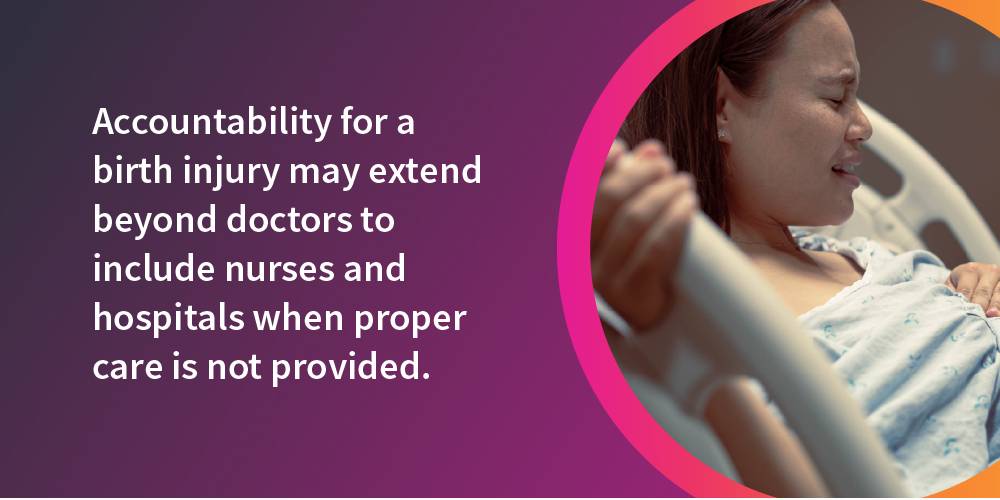
Responsibility is not always limited to the individual nurse. In many cases, the hospital can also be held liable for its employee’s negligence. The hospital may share responsibility if it failed to train or supervise nurses properly, or if its staffing levels made safe care impossible. An attorney can help families sort out who may be legally responsible and build a clear timeline showing what went wrong.
What Compensation Can You Get for a Birth Injury in 2026?
Every birth injury case is different, but many families face similar types of losses. One major category is medical expenses. This includes the cost of NICU care, surgeries, medications, and follow-up visits. For serious injuries, the future costs may be even larger. Children with brain injuries or physical disabilities may need therapy, special equipment, in-home care, or adaptive technology for many years.
Families can also seek compensation for lost income. A parent may have to miss work or leave a career to care for a child with complex needs. In some cases, the child’s future ability to work will also be limited. The law allows claims for the child’s lost earning potential, even though the child is still an infant.
Non-economic damages are also important. These address the human side of the harm. They may include pain and suffering, emotional distress, and loss of a normal life for both the child and the parents. Illinois does not currently impose a general statewide cap on damages in medical malpractice cases, including birth injury claims. However, the amount a family can recover will always depend on the specific facts, the evidence, and how the injury affects daily life.
In very serious cases involving reckless or shocking conduct, punitive damages may sometimes be available. These are meant to punish especially dangerous behavior and discourage it in the future. An attorney can explain which types of damages may apply in a particular situation and help document the full impact of the injury.
How Long Do You Have to File a Claim for a Birth Injury?
Time limits for filing birth injury claims in Illinois can be confusing. There are usually different rules for the parents’ claims and the child’s claims. For most medical malpractice cases, adults have two years from the time they knew or should have known about the injury to file a lawsuit. The four-year mark is the hard cutoff point for any legal action (735 ILCS 5/13-212).
Birth injury cases involving children are treated differently. Illinois recognizes that some birth injuries are not obvious right away. In many situations, families have up to eight years from the date of the malpractice to bring a claim on behalf of the child, as long as the case is filed before the child’s 22nd birthday.
There may also be special rules if the hospital is owned by a government body, or if a provider tried to hide what happened. Missing a deadline can mean losing the right to seek compensation forever. For that reason, it is very important to speak with a lawyer as soon as you suspect there was a preventable birth injury. The attorney can review your situation, calculate the likely deadlines, and help you act in time.
How Are Birth Injury Claims Resolved?
Most birth injury cases start with an investigation. After you speak with a lawyer, the firm will usually gather medical records, billing records, and other documents. They may work with medical professionals who can review the care you and your baby received and identify where it fell below accepted standards.
If the evidence supports a claim, the attorney may first try to negotiate with the hospital’s insurance company. This often involves a detailed demand letter that explains what went wrong, how the nurse and other providers were negligent, and what losses your family has suffered. Negotiations can lead to a settlement, where the hospital or its insurer agrees to pay a certain amount without admitting fault.
When a fair settlement is not possible, the lawyer can file a lawsuit in court. The case then enters a phase called discovery, where both sides exchange documents and take depositions, which are formal interviews under oath. Many cases still settle during or after discovery, sometimes with the help of mediation. Only a small percentage go all the way to trial, where a judge or jury decides who is responsible and how much compensation to award.
Contact a Cook County, IL Birth Injury Lawyer
If you believe a nurse’s mistake contributed to your baby’s injury, you do not have to find answers on your own. At Birth Injury Law Alliance, Ltd., our Cook County, IL birth injury attorneys can review your medical records, explain how Illinois law applies to your situation, and help you understand your options for moving forward. Call 312-462-4200 to set up a free consultation.

312-462-4200
60 W Randolph Street, Suite 400,
Chicago, IL 60601


Contact Our Firm
 The use of the Internet or this form for communication with the firm or any individual member of the firm does not establish an attorney-client relationship. Confidential or time-sensitive information should not be sent through this form.
I have read and understand the Disclaimer and Privacy Policy.